
28th Sunday in Ordinary Time
October 7, 2026
Gospel Reflection
Matthew 22:1-14
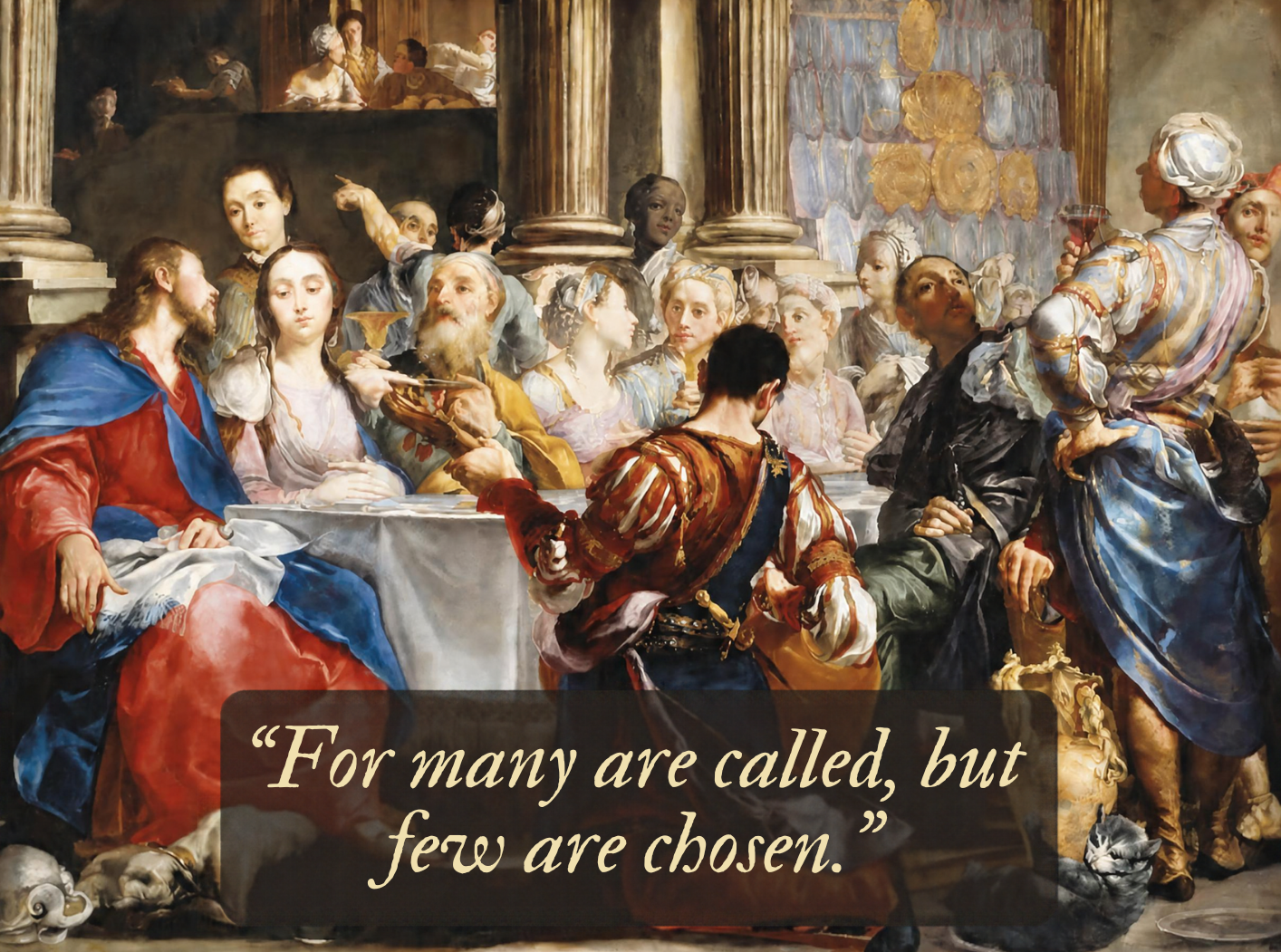
Sacred Scripture, that body of inspired writings that forms an essential part of God’s revelation to his children, often speaks to us of what “no eye has seen, nor ear heard, nor the heart of man conceived.” This is especially true when it offers us images and comparisons of what “God has prepared for those who love Him” (1 Cor. 2:9). So Isaiah is moved to write of a “rich banquet” and Jesus Himself speaks in a parable of a wedding feast, a great marriage celebration, to which all and sundry are invited.
These images are not literal descriptions. No word description could be sufficient for the actual experience of being with God and with all those who love Him. They are comparisons with what in our present experience produces contentment, some real degree of satisfaction. How-ever, they must be understood on the deepest level. Otherwise, we will fail to glimpse what God’s rewards are really like. For instance, if the image of a banquet with a great variety of foods and drink on offer were taken on surface value, any more reflective person would end up disappointed. We all have experienced how a hefty meal may leave us out of sorts, or how at times food, nor matter how attractively presented, may even repel. What is really being presented by the image is that which satisfies the deepest need of nourishment of the human spirit, the need for intimate union with God, the cause of all being and life.
Equally, the parable Jesus tells of a wedding feast speaks to us of the love of God for his children – firstly, his eternal Son, then all those whom He seeks to save through the Son who has become Man. For the Son, Jesus, has come to gather together all men and women into a single family, the Church. The Church is the Spouse or Bride, who is not directly mentioned in the parable, the Bridegroom clearly being Jesus Himself. The wedding feast is an image of heaven, where the marriage bond is sealed – an intimate and everlasting union is achieved - between us and Jesus, between God and his children.
But just as there can be no marriage if a woman refuses the offer of a man, so no man or woman enters heaven – to which God invites all - contrary to their own will and acceptance. This willingness needs to be demonstrated in some way. So in the parable Jesus refers to the custom of those times to put on a special garment before entering the wedding hall. The garment, we may interpret, is the forgiveness and grace that God Himself offers us. It is, in St Paul’s words, to “put on Jesus Christ” (cf Romans 13, 14; Gal 3:27), to accept his call to repentance, to embrace his Truth, to be ready to live by his commandments and precepts, with his own strong and loving arm to support us.
While God’s generosity and willingness to forgive are limitless, the human will can still present what is an insurmountable obstacle for entering into intimate union with Him. It is the choice of not accepting God’s unique position in the order of reality. It is the rebellion of deliberately rejecting his just commandments. It is the proud attitude of saying in word, action or consented thought, I will not obey, I will not cooperate, I will not give up what separates me from God. It is insurmountable because God will not act against our own freedom. We all experience and hopefully acknowledge our personal weaknesses, faults and perhaps moments of rebellion. These need not bar the way to heaven, so long as we have the humility and heart to turn back to our Father God and seek reconciliation and amendment. How helpful in this regard is the sacrament of confession, even when we have not gone so far as to put aside the wedding garment.